Audio Guide Naples – the Cathedral – Back
officially known as the Metropolitan Cathedral of Santa Maria Assunta, it stands majestically along the city street of the same name, incorporating a stratified complex of buildings that tell over two thousand years of history.
Keep reading
An Italian national monument and the religious heart of the city, it is the seat of the Archdiocese of Naples and the scene of the famous rite of the dissolution of the blood of San Gennaro, celebrated three times a year. The site on which the Cathedral stands is full of ancient sacredness: already in Greek times it housed a temple dedicated to Apollo, which was followed by some of the first early Christian churches in the city. This stratification has left visible traces: remains of Roman and early medieval structures have been found under the floor of the Cathedral, which are now accessible thanks to archaeological excavations and explanatory panels. The construction work began in 1294, commissioned by Charles II of Anjou, who called French architects and renowned Italian workers, including the famous Giovanni and Nicola Pisano. Raw materials were reused, such as 110 columns from the Graeco-Roman era, set in the pillars of the naves. The cathedral was completed in 1313 under the reign of Robert of Anjou, and consecrated the following year. During the Second World War, the structure suffered serious damage due to Allied bombing. Between 1969 and 1972 important restorations and consolidations were started that restored stability and splendour to the building.
The façade
has been the subject of numerous renovations: the current one was built in neo-Gothic style by Errico Alvino in the nineteenth century.
It has salient A, with three Gothic portals decorated with marble cusps and a blind rose window, which houses the statue of Christ Blessing, decorated with fifteenth-century elements of great value.
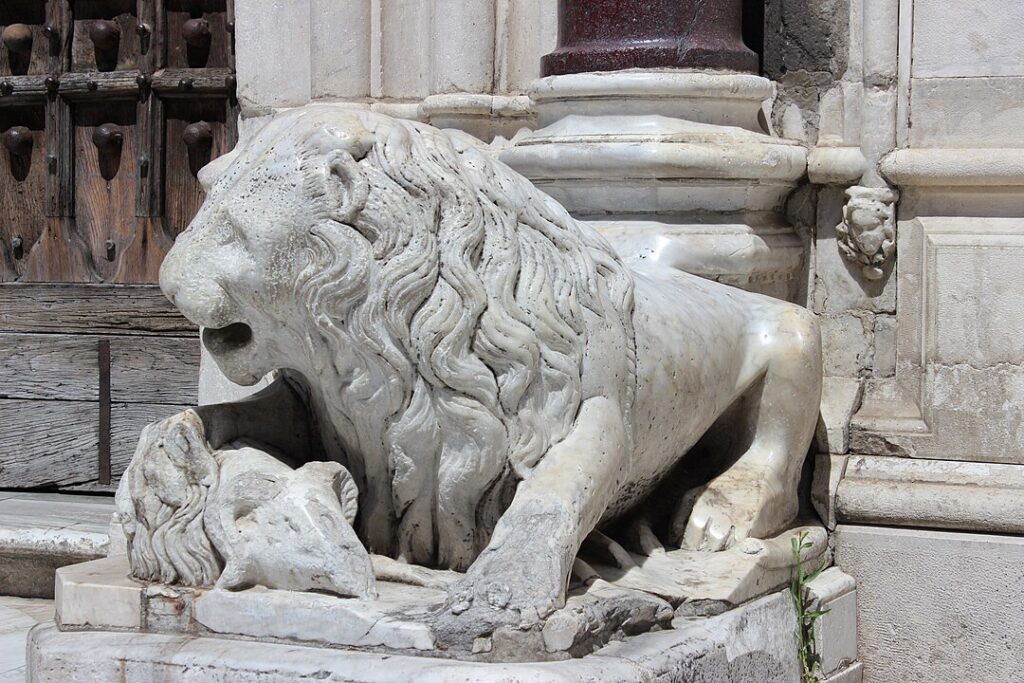
Among these are the sculptures of stylophore lions, by Tino di Camaino.
There are also five windows in Gothic style: Two mullioned windows, Two three-light windows on the side aisles One four-light window on the central nave. The original bell tower, isolated from the cathedral, collapsed in the earthquake of 1349. The base was recovered and reused for the reconstruction of the complex between 1451 and 1457.
The Cathedral is designed on a Latin cross plan, divided into three naves: The central nave, twice as wide as the side aisles, ends with a polygonal apse of over 30 meters, where the main altar stands. Under the tribune is the Chapel of the Succorpo of San Gennaro, an important place of veneration. The side aisles, with cross vaults, end with smaller apses, flanked by Gothic chapels. Continuing along the left transept you enter the Chapel of St. Louis of Toulouse, also known as the Great Sacristy, built in the fourteenth century.
One of the most fascinating treasures is the seventeenth-century baptismal font, consisting of a porphyry stem and an Egyptian basalt basin, decorated with Greek-made Bacchic tubs and masks. a curious example of pagan reuse in a Christian context.
A unique feature of the Cathedral of Naples is that, despite the physical integration, the different buildings incorporated into the construction and pre-existing with respect to the cathedral, are still recognisable and autonomous, each with a distinct historical and stylistic identity.
The Basilica of Santa Restituta, located on the left side of the Cathedral, is separated from the main nave by arches and columns that highlight its early Christian structure, different from the Gothic layout of the central body. It is one of the oldest examples of sacred architecture in Naples.
the Baptistery of San Giovanni in Fonte, accessible from the basilica, has an octagonal plan and ancient mosaics, which make it an autonomous and highly evocative environment. It is recognised as the oldest baptistery in the West.
Finally, worthy of all attention is the Chapel of the Treasure of San Gennaro, located on the right side of the Cathedral, it is a splendid example of Neapolitan Baroque. Sumptuously decorated with polychrome marble, silver and frescoes, it constitutes a world of its own, in stark dissonance with the Gothic rigor of the cathedral.